Scalable quality control with AI
Scalable quality control with AI
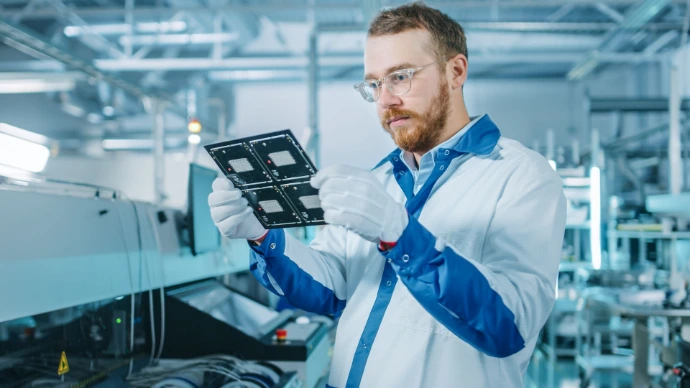
Rising production volumes, new product variants, changing environmental conditions: the demands placed on industrial quality inspection are growing, and traditional systems are quickly reaching their limits.
Conventional inspection systems have to be manually reconfigured every time a change is made. Experienced inspectors are hard to find and retain, and spot checks, which are sufficient for small production volumes, become a source of risk in scaled-up production processes.
This is precisely where AI-powered quality control comes into play. With the help of artificial intelligence, inspection processes can be made significantly more precise, efficient and sustainable.
Why traditional systems are reaching their limits
Traditional automated visual inspection relies on conventional image processing: the software compares an actual image with a stored reference image and triggers an alarm as soon as a deviation exceeds a defined threshold. This usually works well under controlled conditions, but in practice, lighting conditions, material surfaces and manufacturing processes are constantly changing. The result: high rates of false positives, i.e. components that are incorrectly classified as defective. Every false positive costs time, requires rework and undermines confidence in the system.
AI-based systems, on the other hand, learn from real-world image data what constitutes a fault and what does not. They can distinguish between actual defects and non-critical deviations, and improve with every new iteration.
What the research shows
Recent studies show that these improvements are not just empty marketing promises. Researchers at the Free University of Bolzano and the University of Padua have developed a deep-learning-based inspection system for aluminium die-cast components in the automotive industry. The system achieved a defect detection rate of over 95% and reduced inspection time by around 20% compared to manual inspection¹.
A wide-ranging systematic review published in IEEE Access shows that deep learning and computer vision systems consistently outperform traditional inspection methods in automated defect detection across industrial quality control, from semiconductor manufacturing to the textile industry².
Scalability as a system property
The key advantage of modern AI inspection systems lies in the way they handle complexity and growth. A well-designed AI system scales with production rather than having to be rebuilt from scratch every time a change is made. In practical terms, this means:
Programme new products and variants
If a new component or process step needs to be tested, no reprogramming is required. Using a structured approach, new data is collected, the AI is retrained, and the test for the new use case is available within a short time.
Continuously improve existing processes
Every production image captured is potential training data. AI models that are continuously fed with up-to-date data become more accurate over time. This means that the inspection process improves as operations continue, without any extra effort required from the team.
Build resilience to process changes
Changes in lighting conditions, material batches or production parameters – which would immediately throw traditional image processing systems off-cycle – can be learned and compensated for by an AI model.
Roll out to other production lines
A trained model can be applied to similar production lines without having to start from scratch. This means that the investment in data collection and model development can be put to use in multiple ways.
ModOFFICE: Scalable quality control without the need for programming skills
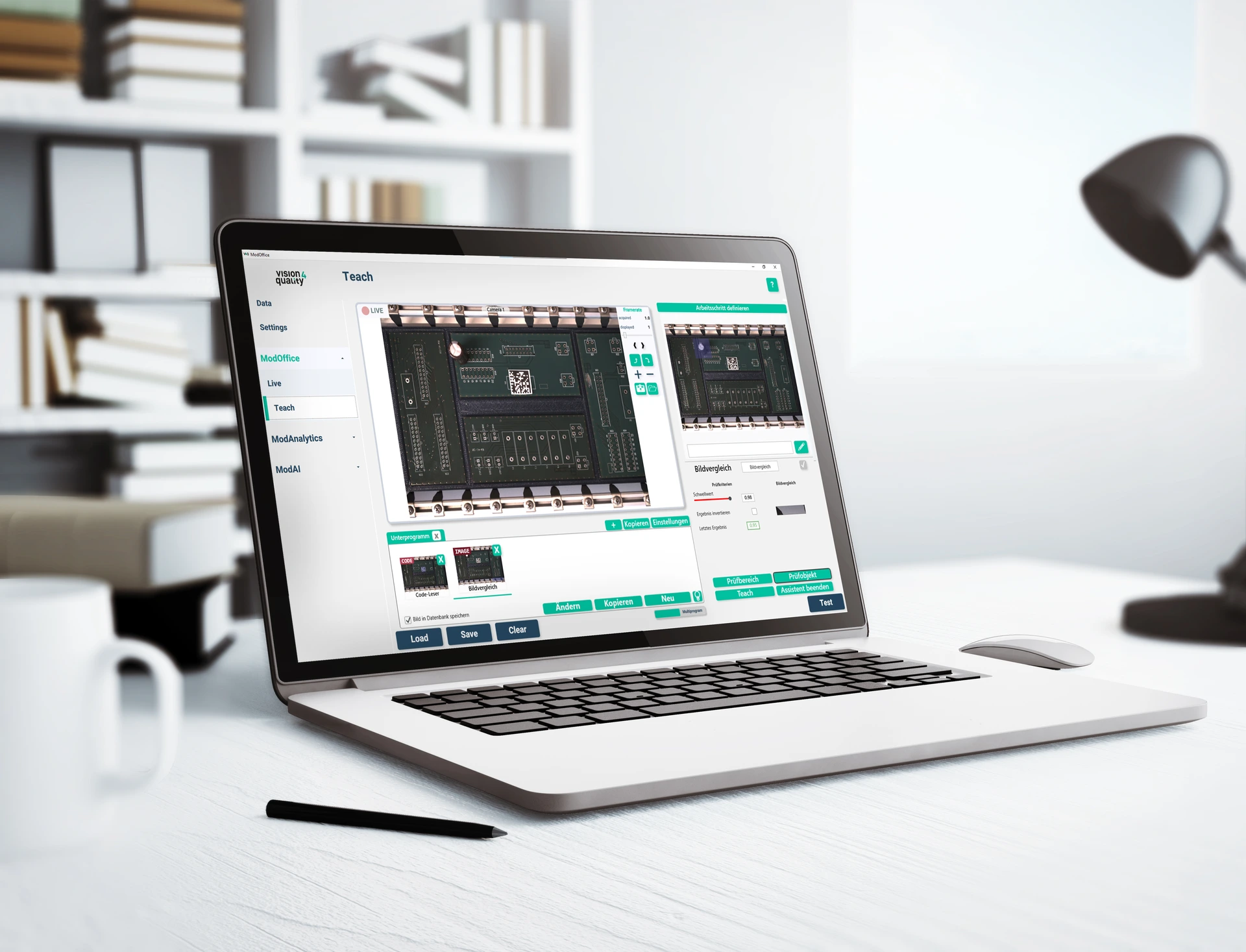
With ModOFFICE, this approach can be implemented without specialist knowledge. The software has been designed from the ground up using an iterative approach: in just a few clicks, in-house production data is transformed into ready-to-use AI models for automatic optical inspection, without the need for any programming skills or external service providers.
The iterative structure makes it possible to quickly create new use cases, continuously improve existing models and permanently utilise collected image data in a dedicated database. Existing data never becomes obsolete, but is incorporated into the training process, making the models more robust in the face of changes in the manufacturing and environmental context.
The result is a quality control system that does not become a bottleneck with every stage of growth, but scales with production.
Learn more here!
Conclusion
AI-powered quality inspection is no longer a technology of the future – it has become established in industrial practice and delivers measurable results. The key difference compared to traditional systems lies not only in higher detection accuracy, but also in the inherent ability to scale: training the system on new processes, improving existing ones, and rolling it out to new production lines – all without having to start from scratch every time.
If you’d like to find out how you can use ModOFFICE’s artificial intelligence in your production environment, please feel free to contact us!
¹ https://www.tandfonline.com/doi/full/10.1080/21693277.2024.2378199
² https://ieeexplore.ieee.org/document/10663422
Author: Thomas Möller